Biomass Energy Utilization and the Decarbonization Goal
Kingwood · May 26, 2026
Biomass Energy: Feedstock Scope, Installed Scale, and Decarbonization Relevance
Biomass energy—chemical energy stored in biological matter through photosynthesis—ranks as the world’s fourth-largest energy source after coal, oil, and natural gas. Its feedstock base spans agricultural residues, forestry waste, livestock and poultry manure, municipal solid waste, and sewage sludge, giving it geographic reach that purpose-built energy crops alone cannot match.
The available resource base is substantial. In Hunan Province—a subtropical region with high agricultural and forestry activity—the estimated annual biomass energy resource suitable for power generation reaches 20.3 million metric tons. Scaled nationally, China’s underdeveloped biomass resource base represents a significant and largely untapped contribution to the clean energy transition.
What distinguishes biomass from other renewables in the decarbonization context is dispatchability. Unlike intermittent sources, biomass-fired generation runs on demand, making it a practical near-term instrument for reducing fossil fuel dependency in power and industrial heat sectors without requiring grid storage investment.
Carbon Intensity Data: The Quantitative Case for Biomass Power
The decarbonization argument for biomass energy utilization rests on a single measurable parameter: carbon emission intensity. When agricultural and forestry biomass is combusted for power generation, its carbon emission intensity equals only 1.8% of coal, 2.1% of oil, and 3.8% of natural gas—figures sourced from the 2021 National Renewable Energy Power Development Monitoring and Evaluation Report published by China’s National Energy Administration.
This near-zero net carbon profile reflects the closed carbon cycle intrinsic to biomass: CO₂ released during combustion was absorbed from the atmosphere during the plant’s growth phase. When feedstock is sourced and managed sustainably, biomass power generation produces negligible net greenhouse gas addition—a fundamental contrast to fossil fuel combustion.
Four commercially deployed generation routes leverage this property:
- Agricultural and forestry biomass combustion — direct combustion of pelletized or chipped plant residues in dedicated boilers or co-firing arrangements.
- Waste incineration power generation — energy recovery from municipal solid waste, reducing landfill volume while generating dispatchable electricity.
- Pyrolysis gasification power generation — thermal conversion of biomass to syngas for use in gas turbines or engines.
- Biogas power generation — anaerobic digestion of organic waste, livestock manure, and sewage sludge to produce methane for combustion.
Each route addresses a distinct feedstock category and regional resource profile. Together they form a portfolio approach that can be adapted to local conditions—a critical design consideration for operators planning long-term industrial fuel strategy.
China’s national data confirms the sector’s growth. According to the 2021 National Renewable Energy Power Development Monitoring and Evaluation Report, total renewable energy installed capacity reached 1.063 billion kW by year-end 2021, of which 37.98 million kW was biomass-driven. Biomass generation output totalled 163.7 billion kWh that year—6.6% of all renewable power generated nationally.
Pelletization: Bridging the Gap Between Raw Feedstock and Deployable Fuel
The gap between available biomass resource and deployable fuel is fundamentally a logistics and standardization problem. Raw agricultural and forestry residues are heterogeneous in moisture content, particle size, and bulk density. Moving them efficiently from field or forest to power plant requires densification into a consistent, transportable form.
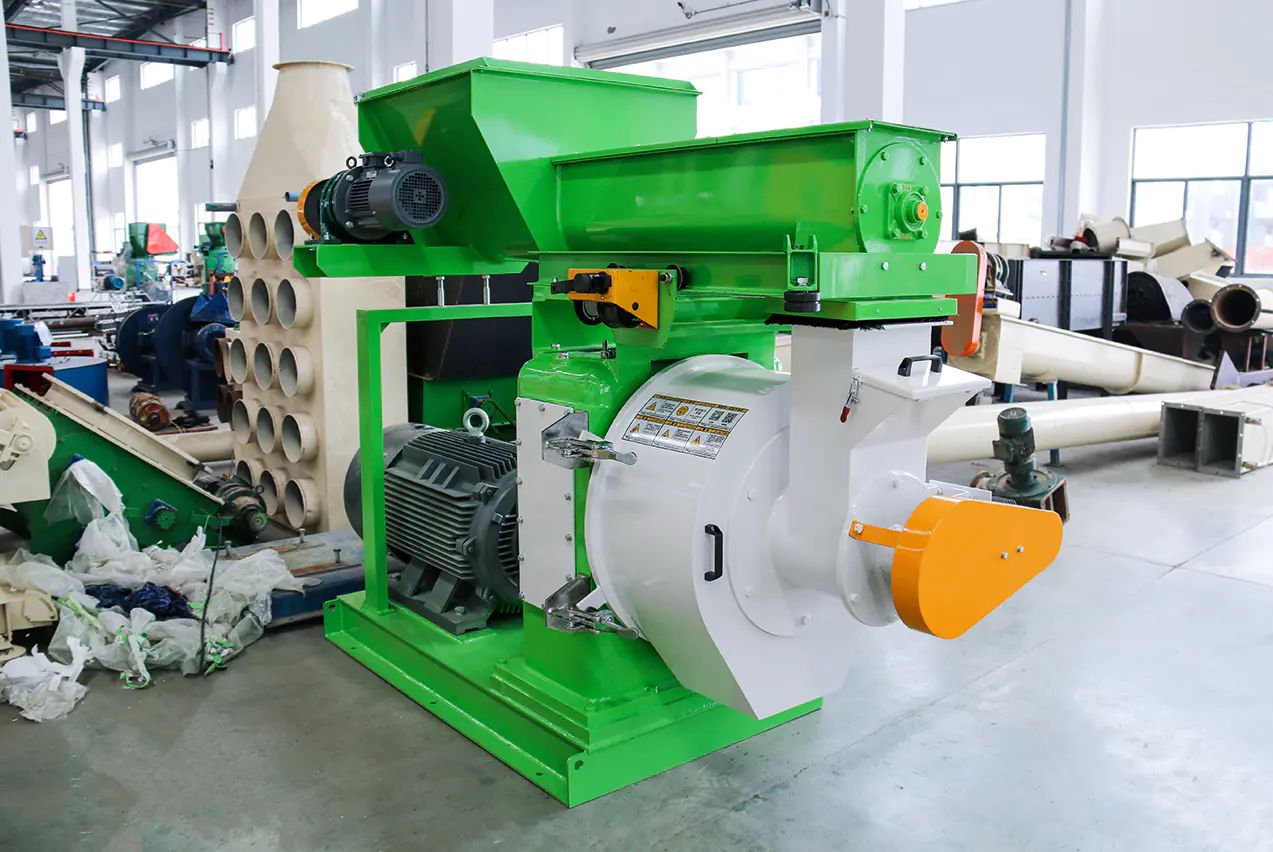
Biomass pelletization resolves this. By processing high-moisture feedstock through sequential crushing, coarse grinding, drying, fine grinding, pelletizing, and packaging, pellet production lines convert variable-quality biomass into standardized, high-energy-density fuel. Kingwood’s wet-feed biomass pellet production lines execute this full process in a fully enclosed, automated workflow with integrated dust removal—fulfilling the Three-Standardization Framework: Integrated, Dust-Free, and Automated production.
Output fuel quality is precisely specified: calorific value of 4,800 kcal/kg, moisture content below 15%, sulfur content below 0.3%, and ash content below 18%—meeting or exceeding EU, ISO, US, and Japanese biomass fuel standards. At that specification, biomass pellets deliver fuel cost savings of 40–50% versus fossil fuel alternatives, with all emissions below GB13271-2001, China’s national boiler air pollutant emission standard.
For large industrial operators, Kingwood engineers complete production lines to annual capacities up to 200,000 metric tons. The pellet mill model range scales from the JWZL-420 at 1–1.5 t/h, through the JWZL-688 at 2–2.3 t/h, the JWZL-688D at 3–3.5 t/h, and the JWZL-928 at 4–5 t/h, to the high-throughput JZWH-860 horizontal pellet mill also rated at 4–5 t/h. Auxiliary equipment—drum chippers, hammer mills, drum dryers, and counter-flow coolers—completes the integrated line.
Commercial project outcomes document the viability. A 24 t/h wood pellet production line commissioned in Vietnam in 2023 and a 12 t/h line in Vietnam in 2024 achieving a 23-month payback period both demonstrate industrial-scale biomass fuel supply at competitive economics.
Biomass Energy Utilization as an Environmental and Policy Instrument
Beyond power generation efficiency, biomass energy utilization addresses a second-order problem: organic waste management. Agricultural residues that would otherwise be open-burned, forestry waste that would decompose and release methane, and municipal organic waste accumulating in landfills can all be redirected into energy production chains.
This simultaneous waste valorization and energy generation creates verifiable co-benefits: reduced open burning (lowering PM2.5 and black carbon emissions), avoided methane from landfill decomposition, and reduced fossil fuel dependence in industrial heat applications. These outcomes align biomass energy utilization directly with carbon peaking targets, carbon neutrality roadmaps, and ambient air quality improvement goals—three policy priorities that frequently conflict but converge in the biomass energy case.
For industrial energy managers and project developers evaluating decarbonization strategies, biomass energy utilization—implemented with properly specified, high-efficiency pellet production equipment—delivers measurable carbon reduction, verifiable fuel cost savings, and regulatory alignment within a single capital investment. Kingwood, founded in 1999 and operating from a 31,200 m² facility in Liyang, Jiangsu, has designed and delivered over 2,000 production line projects across 30 countries, with an aggregate annual biomass fuel production capacity of 10 million metric tons across its installed base.
FAQ
Why is biomass energy considered the fourth-largest energy source globally?
Biomass energy draws on a vast, continuously replenished feedstock base—agricultural residues, forestry waste, livestock manure, municipal solid waste, and sewage sludge—giving it a scalable primary energy contribution that surpasses many other renewables in total output.
What is the carbon emission intensity of biomass power generation compared to fossil fuels?
When agricultural and forestry biomass is used for power generation, its carbon emission intensity equals only 1.8% of coal, 2.1% of oil, and 3.8% of natural gas—making it one of the lowest-carbon dispatchable power sources available.
How large is China's biomass power generation sector?
According to China's 2021 National Renewable Energy Power Development Monitoring and Evaluation Report, cumulative renewable energy installed capacity reached 1.063 billion kW by end-2021, of which 37.98 million kW was biomass-driven. Biomass generation totalled 163.7 billion kWh in 2021—6.6% of all renewable power output.
What types of biomass power generation are commercially deployed?
The four primary routes are: (1) agricultural and forestry biomass combustion, (2) waste incineration power generation, (3) pyrolysis gasification power generation, and (4) biogas power generation. Each suits different feedstock profiles and regional resource bases.
How does biomass energy contribute to both environmental and energy policy goals?
Biomass utilization converts organic waste streams into energy, achieving harmless disposal, volume reduction, and resource recovery simultaneously—supporting carbon peaking and neutrality targets while reducing agricultural and municipal waste loads and improving regional air quality.
What role do biomass pellets play in scaling biomass energy utilization?
Densification into biomass pellets standardizes feedstock handling, raises calorific value, and enables long-distance transport—connecting dispersed agricultural and forestry residues to centralized power plants or industrial boilers. Kingwood's pellet production lines process high-moisture biomass through integrated crushing, drying, pelletizing, and packaging in a fully enclosed, dust-free workflow.
What equipment does Kingwood supply for biomass energy projects?
Kingwood manufactures a complete range of biomass pellet production equipment including the JWZL-420, JWZL-688, JWZL-688D, JWZL-928, and JWZL-1068 vertical pellet mills and the JZWH-860 horizontal pellet mill, alongside drum chippers, hammer mills, drum dryers, and counter-flow coolers. Complete wet-feed production lines are engineered to annual capacities up to 200,000 metric tons.
- By end-2021, China's cumulative biomass power installed capacity reached 37.98 million kW, generating 163.7 billion kWh—6.6% of total national renewable energy output. (2021, 2021 National Renewable Energy Power Development Monitoring and Evaluation Report, National Energy Administration of China)
- Agricultural and forestry biomass power generation produces carbon emissions at just 1.8% of coal's intensity, 2.1% of oil's, and 3.8% of natural gas's intensity per unit of electricity. (2021, 2021 National Renewable Energy Power Development Monitoring and Evaluation Report, National Energy Administration of China)