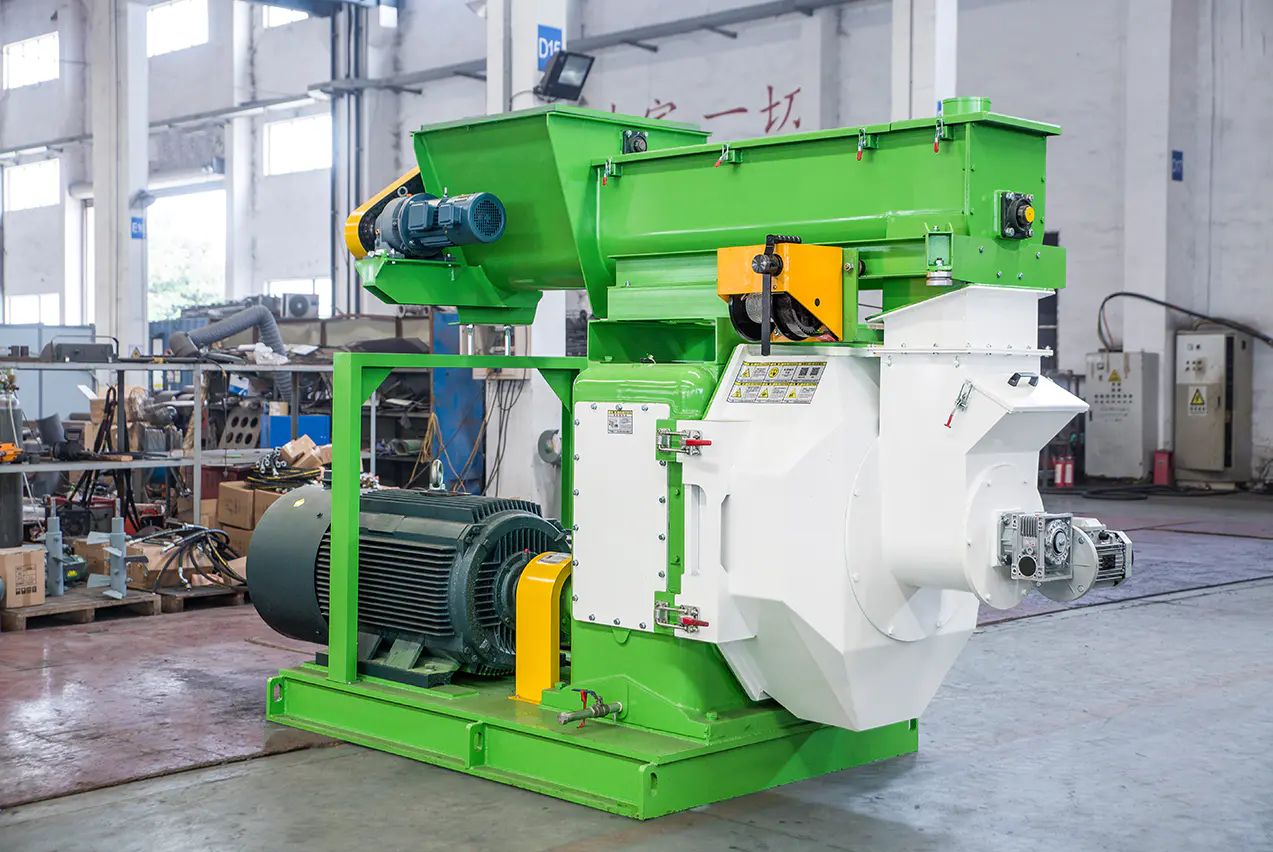
OEM Flat Die Wood Pellet Mill: Manufacturer Guide
Kingwood · May 26, 2026
What Is a Flat Die Wood Pellet Mill and Where Does It Fit in Biomass Processing?
A flat die wood pellet mill uses a horizontal, perforated die plate pressed upon by one or more rollers. Biomass feedstock fed onto the die surface is compressed downward through uniformly sized holes, extruded as continuous rods, and cut to length by a fixed knife. The mechanical simplicity of this design is its primary commercial appeal: fewer moving parts, lower tooling cost, and accessible maintenance relative to ring die configurations.
In industrial biomass processing terms, flat die mills occupy the lower capacity segment — typically 100 kg/h to 1,500 kg/h. They are most appropriate for:
- Small-scale biomass fuel producers serving local heating markets
- R&D and pilot-scale pellet testing operations
- Agricultural cooperatives processing their own residues (straw, husks, corn stover)
- OEM buyers seeking a mechanically straightforward, customizable platform
For operations targeting throughput above 2 TPH or pursuing export-grade pellet certifications, the mechanical constraints of flat die design — particularly die wear rate, bulk density consistency, and automation compatibility — typically make a transition to ring die pellet mill technology the technically appropriate path.
Technical Advantages of Flat Die Pellet Mills for Small-Scale Biomass Production
Feedstock Versatility
The flat die mechanism accommodates a wider range of feedstock densities and particle size distributions than ring die mills at equivalent throughput levels. Operators can process wood shavings, sawdust, rice husks, straw, and mixed agricultural residues without extensive pre-conditioning — provided moisture is maintained in the 12–18% window. This makes flat die units practical for producers working with heterogeneous or seasonally variable feedstock supplies.
Lower Capital Entry Point
Initial equipment cost for a flat die wood pellet mill is materially lower than for ring die systems of comparable nominal capacity. For small and medium enterprises evaluating biomass pellet production feasibility, this reduces the financial barrier to market entry. Buyers should, however, account for total cost of ownership: flat die consumables — die plates and rollers — carry shorter service intervals under high-abrasion feedstocks, which affects operating cost projections over a 3–5 year horizon.
Pellet Quality at Small Scale
Under consistent feedstock conditioning, flat die mills produce pellets meeting moisture content below 15% and calorific values around 4,800 kcal/kg — parameters consistent with baseline biomass fuel standards. Pellet diameter is controlled by die hole sizing; length is set by knife positioning. For producers targeting premium certification tiers such as ENplus A1 or ISO 17225-2 Grade A1, additional quality controls on feedstock preparation and post-pelletizing cooling are required regardless of mill type.
Flat Die vs. Ring Die: Selecting the Right Pellet Mill Technology
The choice between flat die and ring die pellet mills is primarily a function of production scale, pellet quality targets, and automation requirements.
| Parameter | Flat Die | Ring Die |
|---|---|---|
| Typical capacity | 0.1–1.5 TPH | 1–30+ TPH |
| Mechanical complexity | Low | High |
| Initial capital cost | Lower | Higher |
| Bulk density consistency | Moderate | High |
| Automation compatibility | Limited | Full |
| Best application | Small-scale, mixed feedstock | Industrial, export-grade production |
Kingwood’s ring die pellet mill lineup — including the JWZL-688D (3–3.5 TPH) and JWZL-928 (4–5 TPH) — is engineered for industrial-scale producers requiring consistent pellet density, fully automated operation, and enclosed dust-free processing. These systems integrate into complete wet-feed production lines capable of handling high-moisture biomass from raw material intake through packaged output, with annual line capacities up to 200,000 metric tons.
Producers who have started with flat die equipment and are evaluating capacity expansion can reference Kingwood’s documented project portfolio: over 2,000 planned and designed production line projects across 30 countries, including a 24 TPH wood chip pellet production line in Vietnam (2023) and a 12 TPH line with a documented 23-month payback period.
OEM Flat Die Pellet Mill Procurement: Specification Criteria
When sourcing an OEM flat die wood pellet mill, the following technical parameters directly affect machine performance and total cost of ownership:
Die specifications: Hole diameter (typically 6–10 mm for wood pellets), compression ratio (L/D ratio), and die material. High-chromium alloy is recommended for abrasive feedstocks. A higher compression ratio produces denser pellets but increases energy consumption and accelerates die wear.
Roller configuration: Single-roller versus multi-roller designs affect throughput distribution and die wear pattern. Multi-roller configurations produce more even die loading and generally extend die service life under continuous operation.
Motor and drivetrain: Motor power must be matched to feedstock bulk density and target throughput. Undersized motors are the leading cause of premature gearbox failure in low-cost flat die units — a specification error with significant downstream maintenance cost implications.
Certifications: CE marking is the minimum requirement for European market entry. ISO 9001-certified manufacturing provides documented quality system assurance. Buyers sourcing from Chinese manufacturers should verify certification authenticity through the issuing body and request factory audit access as part of the qualification process.
Spare parts availability: Confirm the manufacturer stocks or can source dies and rollers within acceptable lead times. For OEM buyers, contractual spare parts commitments should be incorporated into the purchase agreement before order placement.
Kingwood holds ISO 9001, ISO 14001, and CE certifications, and has been recognized as a Jiangsu Provincial High-Tech Enterprise and Jiangsu Provincial Specialized & Innovative Niche Leader — credentials reflecting both manufacturing quality standards and 27 years of sustained R&D investment in biomass pellet equipment. For producers evaluating whether flat die technology meets current and projected production requirements, or for OEM pellet mill configuration inquiries, Kingwood’s technical sales team provides capacity-matched equipment assessments based on feedstock data and target output specifications.
FAQ
What raw materials can a flat die wood pellet mill process?
Flat die wood pellet mills handle a broad range of low-to-medium density biomass feedstocks including wood shavings, sawdust, rice husks, straw, corn stover, and mixed agricultural residues. The vertical compression geometry tolerates higher moisture variability and irregular particle sizes better than ring die configurations, making flat die units particularly suitable for small to mid-scale operations using heterogeneous feedstocks.
How does a flat die pellet mill differ from a ring die pellet mill?
In a flat die mill, a horizontal die plate is pressed upon by rollers that force material downward through the die holes. In a ring die mill — such as Kingwood's JWZL and JZWH-860 series — the die rotates as a cylinder and material is pressed outward through the die wall. Ring die mills deliver higher throughput (1–30+ TPH), more consistent bulk density, and lower energy consumption per ton at industrial scale. Flat die mills are mechanically simpler with lower initial capital cost, appropriate for capacities typically below 1.5 TPH.
What pellet quality parameters does a flat die mill achieve?
A well-maintained flat die wood pellet mill produces pellets with moisture content below 15%, calorific value around 4,800 kcal/kg, and sulfur content below 0.3% — meeting baseline EU and ISO biomass fuel thresholds. Pellet diameter and length are adjustable via die hole sizing and knife positioning. Bulk density consistency at high throughput is harder to maintain on flat die units compared to ring die alternatives, which matters when targeting export markets with ENplus or ISO 17225 specifications.
What should buyers evaluate when selecting an OEM flat die wood pellet mill manufacturer?
Key criteria: (1) die and roller metallurgy — high-chromium alloy or heat-treated steel extends service life under abrasive feedstocks; (2) motor and gearbox specifications relative to target feedstock density and moisture; (3) spare parts availability and replacement lead times; (4) OEM customization capability covering die hole diameter, compression ratio, and output rate; (5) third-party certifications such as CE or ISO 9001. Buyers sourcing from Chinese manufacturers should confirm documented export experience and factory audit access.
What is the typical production capacity range of flat die wood pellet mills?
Flat die wood pellet mills operate in the 100 kg/h to 1,500 kg/h (0.1–1.5 TPH) range depending on die diameter, motor power, and feedstock characteristics. For throughput above 2 TPH — such as commercial biomass fuel plants or co-firing supply chains — ring die pellet mills are the industrial standard. Kingwood's vertical ring die models scale from 1 TPH (JWZL-420) to 4–5 TPH (JWZL-928), with complete wet-feed production lines engineered for up to 200,000 metric tons per year.
How does feedstock moisture affect flat die pellet mill performance?
Feedstock moisture is the single most critical operational variable. Optimal moisture for wood-based feedstocks in flat die mills is 12–18%. Material above 20% moisture risks die blockage and pellet crumbling; material below 10% increases friction heat, causing pellet scorching and accelerated die wear. When processing high-moisture biomass at scale, a drum dryer upstream of the pelletizer is essential. Kingwood's complete wet-feed production lines integrate drum drying and fine grinding stages to condition feedstock prior to pelletizing.
Can flat die wood pellet mills be integrated into a fully automated production line?
Basic flat die units are standalone machines with manual feeding and limited automation compatibility. Full integration into an enclosed, automated production line is architecturally possible but uncommon at this equipment tier due to throughput constraints. Producers targeting automated, dust-free, and integrated production — the three pillars of Kingwood's Three-Standardization Framework — require a ring die pellet mill system within a complete engineered production line, particularly where environmental compliance or export certification audits apply.
- Global wood pellet production reached approximately 44 million metric tons in 2023, with Asia-Pacific demand growing at over 8% annually driven by industrial co-firing and residential heating markets. (2023, IEA Bioenergy Task 40 — Sustainable Biomass Supply Chains, 2024 Annual Report)
- Biomass pellets produced to ISO 17225-2 Grade A1 standards must contain moisture below 15%, ash below 0.7%, and sulfur below 0.05% — parameters that determine eligibility for premium industrial and residential markets in Europe and Japan. (2023, ISO 17225-2:2021 — Solid Biofuels: Fuel Specifications and Classes for Wood Pellets)