Eco-Friendly Alternatives to Wood Pellet Press Machines
Kingwood · May 26, 2026
The Case for Moving Beyond Virgin Wood Feedstocks
Conventional pellet production has long depended on wood as its primary feedstock. That approach is technically sound, but it places sustained pressure on forest resources and ties plant economics to timber supply chains subject to price volatility and regulatory risk. As industrial biomass fuel demand expands across power generation, district heating, and coal co-firing applications, equipment buyers and plant operators are asking a more precise question: are there eco-friendly alternatives to conventional wood pellet press machines that maintain output quality while reducing the environmental footprint of the full production process?
The answer is yes—and the viable solutions operate at three distinct levels: feedstock substitution, energy source diversification, and production system architecture.
Feedstock Alternatives: Agricultural Residues as a Primary Input
The most impactful change available to pellet producers today is feedstock diversification away from virgin wood. Wheat straw, corn stover, rice husks, and sugarcane bagasse are chemically and physically suitable for densification into biomass pellets. FAO data places global agricultural residue availability above 5 billion metric tons annually—a feedstock base that carries no deforestation liability and is available at or near existing agricultural operations.
Processing these residues through a pellet mill requires careful attention to feedstock preparation. Moisture content, particle size distribution, and lignin content vary significantly across residue types, directly affecting die selection, conditioning parameters, and achievable throughput. Kingwood’s wet-feed production line architecture addresses this variability through an integrated processing sequence: drum chipping, coarse grinding, drum drying, fine grinding, and pelletizing in a fully enclosed, automated system. This multi-stage approach accommodates high-moisture, heterogeneous feedstocks that would be unsuitable for simpler single-stage configurations.
Pellets produced to specification through this process meet internationally recognized quality thresholds. Kingwood biomass pellets achieve 4,800 kcal/kg calorific value, moisture below 15%, sulfur below 0.3%, and dioxin emissions below 0.5 ng TEQ—figures that comply with EU moisture standards, Japan’s sulfur limit of ≤0.5%, and ISO ash content limits below 20%, while remaining well within China’s GB13271-2001 boiler emission standard.
For a documented example of high-throughput production from diverse biomass feedstocks, the 24 t/h Vietnam wood chip pellet production line provides detailed operational reference.
Renewable Energy Integration and Advanced Pelletization Methods
The second axis of sustainable pellet production is the energy source powering the equipment. Ring die pellet mills are electrically intensive; the carbon intensity of the plant’s electricity supply directly determines the lifecycle emissions profile of the fuel produced. Solar and wind power can supply plant electrical loads, and where grid-connected renewable procurement is available, it represents a straightforward emissions reduction lever requiring no modifications to the pelletizing equipment itself.
At the process level, natural binders—vegetable oils, plant-based polymers, and lignocellulosic extracts—are being evaluated as alternatives to synthetic binding agents. In certain feedstock combinations, these binders support pellet formation at reduced compression pressures, lowering specific energy consumption per ton of output and eliminating synthetic additive residues from the finished fuel. The resulting pellets are fully biodegradable and compatible with existing industrial combustion infrastructure.
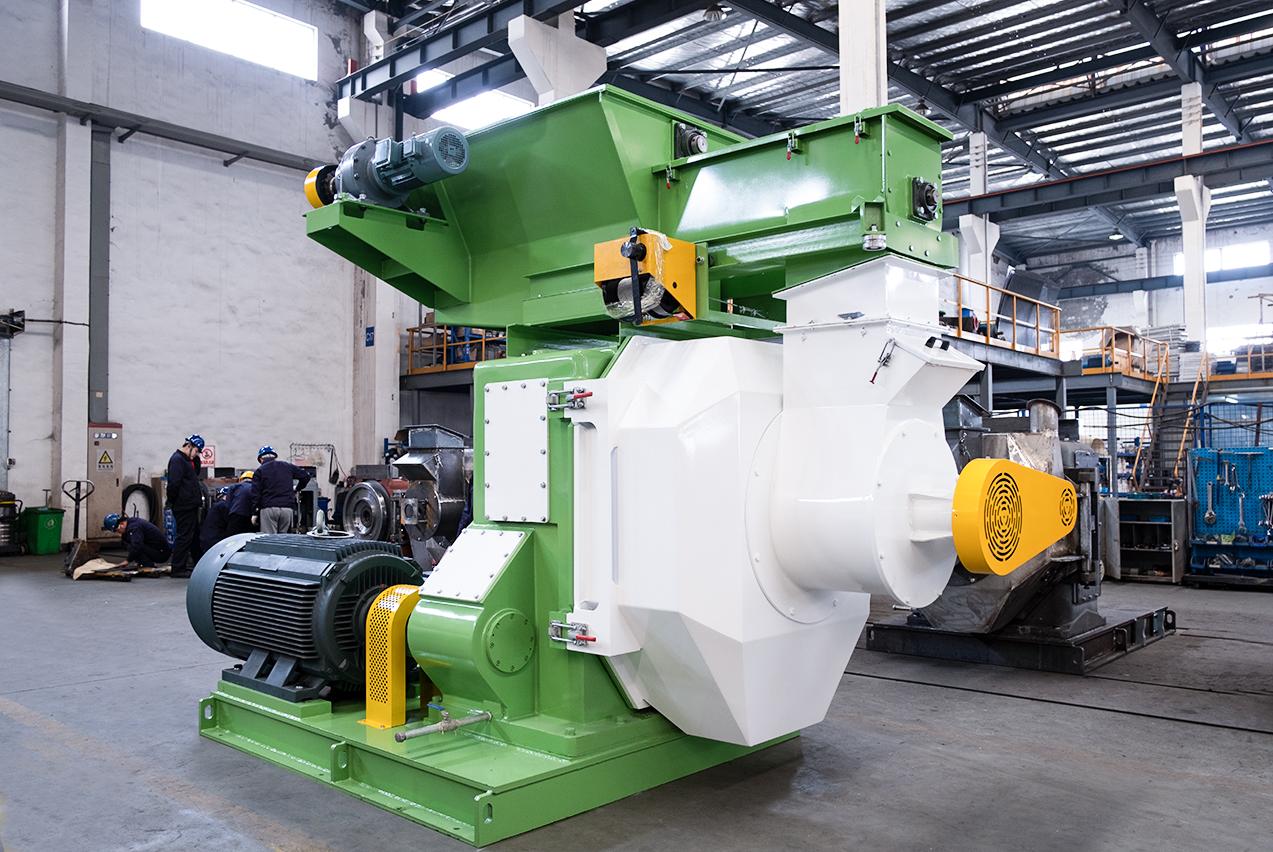
Kingwood’s ring die pellet mill designs support these process variations across the full product range. The vertical pellet mill lineup includes the JWZL-688D at 3–3.5 t/h and the JWZL-928 at 4–5 t/h, with the horizontal JZWH-860 also rated at 4–5 t/h for continuous industrial-scale operation. All models are engineered for consistent densification across variable feedstock and binder combinations.
Kingwood’s Three-Standardization Framework—governing Integrated, Dust-Free, and Automated production line design—ensures that renewable energy integration and alternative binder systems can be implemented without compromising plant hygiene, dust control, or operational continuity. View full specifications for the JZWH-860 horizontal biomass pellet mill.
Decentralized Production Systems: Reducing Logistics Emissions at Scale
A third structural alternative gaining traction in industrial procurement is decentralized plant architecture. Large centralized facilities achieve equipment utilization efficiencies but generate substantial transport emissions moving raw biomass from dispersed collection points to a single processing location. For low-bulk-density feedstocks such as agricultural straw, haulage costs and associated diesel consumption can represent a significant share of total lifecycle environmental impact.
Decentralized systems—smaller production lines positioned at or near biomass collection zones—compress the supply chain, reduce feedstock logistics emissions, and enable faster operational response to seasonal feedstock availability. They also distribute economic value to agricultural communities rather than concentrating it at a single industrial site, a factor increasingly relevant in public permitting and stakeholder engagement for new biomass projects.
Kingwood’s production line design capability, developed across more than 2,000 production line projects in over 30 countries, supports both centralized and decentralized configurations. Complete line designs scale from compact regional facilities up to 200,000 metric tons per year of annual capacity, with full automation, enclosed processing, and integrated dust removal standard across all configurations.
The Guizhou Dust-Free biomass pellet mill workshop demonstrates how Kingwood’s Dust-Free production line standard performs in practice—a critical consideration for decentralized plants operating near agricultural communities where dust and emissions compliance is subject to close regulatory scrutiny.
Selecting the Right Approach for Your Operation
No single eco-friendly alternative applies universally. The optimal configuration for a given project depends on local feedstock availability and moisture profile, grid energy mix and renewable procurement options, required throughput and capital budget, and the emissions and fuel quality standards applicable in the target market.
Kingwood’s engineering team—backed by 27 years of R&D in biomass pellet equipment and ISO 9001 and ISO 14001 certified quality systems—supports buyers through this evaluation from initial feedstock characterization and line configuration through to commissioning, operator training, and after-sales technical service. With biomass pellets consistently demonstrating 40–50% fuel cost reductions versus fossil fuel alternatives across operational projects, the economic justification for sustainable pellet production is as compelling as the environmental one.
FAQ
What feedstocks can replace wood in biomass pellet production?
Agricultural residues including wheat straw, corn stover, rice husks, and sugarcane bagasse are proven substitutes for virgin wood. These materials reduce pressure on forest resources, divert waste from landfills, and can be processed through the same pelletizing equipment used for wood feedstocks, provided feedstock preparation parameters are properly configured.
Can pellet mills run on renewable energy?
Yes. Solar and wind power can supply the electrical load of pellet mill operations, directly reducing lifecycle carbon emissions from the production process. Pairing renewable energy with high-efficiency equipment such as the JZWH-860 horizontal pellet mill (4–5 t/h) delivers industrial throughput with a substantially lower carbon footprint.
What are natural binders and why do they matter for sustainable pellet production?
Natural binders derived from vegetable oils or plant-based polymers agglomerate biomass particles without synthetic additives. In certain feedstock combinations they enable pellet formation at lower compression pressures, reducing specific energy consumption per ton of output and yielding a fully biodegradable pellet compatible with existing combustion infrastructure.
How does decentralized pellet production improve sustainability?
Positioning smaller production lines near biomass collection zones compresses the supply chain, reduces diesel consumption in feedstock haulage, and lowers logistics-related emissions—particularly relevant for low-bulk-density feedstocks such as agricultural straw. Decentralized plants also distribute economic benefit to agricultural communities.
What emission performance do Kingwood biomass pellets achieve?
Kingwood biomass pellets achieve a calorific value of 4,800 kcal/kg, moisture content below 15%, sulfur content below 0.3%, and dioxin emissions below 0.5 ng TEQ—all below China's GB13271-2001 boiler air pollutant emission standard and compliant with EU moisture, ISO ash, and Japan sulfur thresholds.
How much cost saving can biomass pellets deliver versus fossil fuels?
Switching from fossil fuels to biomass pellets delivers a 40–50% reduction in fuel costs, based on Kingwood operational project data across more than 30 countries served.
What production capacity does Kingwood's complete wet-feed pellet line support?
Kingwood's fully automated, enclosed wet-feed production lines are designed for capacities up to 200,000 metric tons per year, integrating drum chipping, coarse grinding, drum drying, fine grinding, pelletizing, and packaging in a single dust-free process.
- Global biomass pellet demand is projected to exceed 50 million metric tons per year by 2027 as industrial users accelerate coal-to-biomass fuel switching. (2024, IEA Renewables 2024 Report)
- Agricultural residue availability worldwide exceeds 5 billion metric tons annually, representing a feedstock base that substantially exceeds current pellet industry consumption. (2023, FAO Agricultural Outlook 2023–2032)