Wood Hammer Mill: Crushing Biomass for Pellet Lines
Kingwood · May 26, 2026
What Is a Wood Hammer Mill and How Does It Work
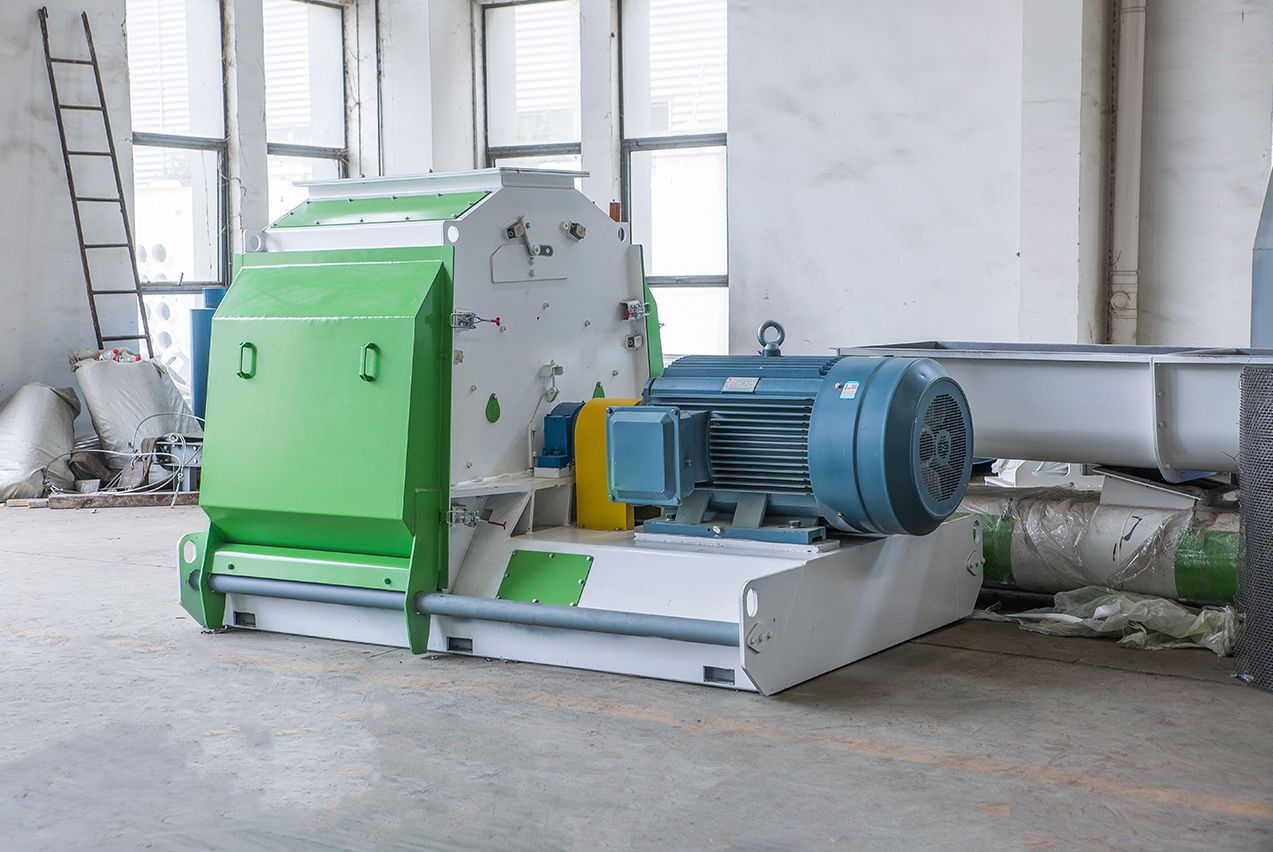
A wood hammer mill—also called a wood hammer machine or wood hammer crusher—is a high-speed impact size-reduction machine designed to process lignocellulosic biomass into uniform particles suitable for pelletizing, briquetting, or direct combustion. It is a standard upstream component in any industrial biomass pellet production line.
The operating principle is straightforward: feedstock enters the crushing chamber where high-speed rotating hammers—mounted on a disc rotor and driven by a motor through a V-belt—impact the material repeatedly against hardened grinding plates. Once particles are reduced below the screen aperture size, they exit through the screen holes. Oversize particles continue circulating until they pass the screen. The key process variables controlling output particle size are hammer-tip speed, screen aperture, and the gap between hammer face and screen surface.
Kingwood’s electric wood hammer mill series processes wood chips with diameters from 50 mm up to 200 mm and delivers throughputs from 200 kg/h to 500 kg/h per unit. The rotor carries both cutting blades and fan blades; the fan action generates internal airflow that moves crushed particles toward the screen, preventing re-grinding losses and reducing energy consumption per unit output.
An enclosed iron-sheet housing surrounds the rotor assembly, isolating the motor and bearings from fine dust generated during crushing—a design choice that reduces motor winding failures and extends bearing service intervals in continuous industrial operation.
Feedstock Range and Industrial Applications
The wood hammer mill is not limited to clean wood. It handles a broad spectrum of biomass and agricultural residue materials relevant to industrial pellet fuel production:
- Wood-based feedstocks: wood chips, sawdust, timber offcuts, bark
- Agricultural residues: wheat straw, rice hull, cotton stalk, corn stover
- Oil palm derivatives: EFB (empty fruit bunch) fiber, palm kernel shell
- Other biomass: sugarcane bagasse, miscanthus, energy grass
For producers targeting export markets in Vietnam, Japan, or South Korea—where biomass pellet import volumes continue to expand—feedstock flexibility is operationally important. A single hammer mill configuration, adjusted for screen gap and hammer weight, can shift between wood chip campaigns and rice hull campaigns without major equipment changeovers.
In wood pellet fuel production, correctly sized hammer mill output is a prerequisite for consistent pellet quality. Kingwood’s biomass pellets achieve a calorific value of 4,800 kcal/kg, moisture content below 15%, sulfur content below 0.3%, and ash content below 18%—figures that depend partly on correct particle size preparation at the hammer mill stage. Inconsistent output leads to uneven die filling and pellet density variation, which affects calorific value consistency in the finished product.
For a worked example of how upstream equipment specification translates into pellet line economics, see the Vietnam 12 t/h wood pellet line case study, where the line achieved investment payback within 23 months.
Pneumatic heavy-particle separators can be added to the hammer mill infeed circuit to intercept stones, metal fragments, and other dense contaminants before they contact the hammers—protecting both the hammer mill and the downstream ring die from impact damage.
Integration into Complete Biomass Pellet Production Lines
The wood hammer mill does not operate in isolation. In Kingwood’s complete wet-feed biomass pellet production lines—capable of handling high-moisture feedstocks and scaled to annual capacities up to 200,000 metric tons—the hammer mill occupies the coarse-grinding stage within a defined process sequence:
- Drum chipper — reduces raw logs or large wood waste to manageable chip lengths
- Coarse hammer mill — reduces chips to particles suitable for drying
- Drum dryer — reduces moisture content to below 15% for pelletizing
- Fine hammer mill (where required) — achieves target particle size for the specific die specification
- Pellet mill (ring die) — compresses dried, sized particles into dense cylindrical pellets
- Counter-flow cooler — brings pellet temperature and moisture to safe handling levels
- Packaging — automated weighing and bagging for export or domestic supply
This sequence is fully enclosed and automated, consistent with Kingwood’s Three-Standardization Framework: Integrated production lines, Dust-Free production lines, and Automated production lines. The dust-free design addresses a critical safety requirement—enclosed processing reduces explosion risk from fine wood dust, a mandatory consideration for commercial-scale biomass plant insurance and regulatory compliance in most jurisdictions.
For large-volume lines, a cyclone separator is positioned immediately downstream of the hammer mill outlet. The cyclone separates the air-particle mixture produced by the fan-blade rotor action, recovers finished wood fines for direct transfer to the dryer infeed conveyor, and prevents dust recirculation within the mill housing. Without a correctly sized cyclone, fine particles accumulate in the chamber, increasing energy consumption and producing inconsistent screen loading.
Kingwood has planned and designed over 2,000 production line projects across more than 30 countries since its founding in 1999. The 30 t/h wood pellet line in Chongqing, China (2021) and the 24 t/h wood chip pellet line in Vietnam (2023) are examples where hammer mill sizing was matched precisely to pellet mill feed requirements and dryer evaporation capacity, eliminating throughput bottlenecks across the full production sequence.
Selecting the Right Hammer Mill for Your Biomass Line
Buyers specifying a wood hammer mill for a new or retrofit biomass pellet line should evaluate the following parameters against their feedstock and throughput targets:
- Infeed particle size: Maximum chip dimension the mill can accept (Kingwood’s series handles up to 200 mm diameter)
- Target output particle size: Driven by the die hole diameter of the downstream pellet mill; finer screen apertures reduce throughput and increase energy draw
- Moisture content of infeed material: Wet material increases screen blinding risk; hammer mills in wet-feed lines are typically sized with a capacity buffer
- Throughput requirement: Match hammer mill capacity to dryer and pellet mill throughput to avoid starving downstream equipment
- Cyclone and dust extraction: Required for continuous operation above 500 kg/h and mandatory in enclosed workshop configurations
Kingwood’s engineering team, backed by 20 R&D experts and 27 years of dedicated biomass equipment development, provides feedstock-specific equipment selection and full production line layout design. For current model specifications, capacity data, and integration options, contact Kingwood directly or visit the product pages on kingwoodpellet.com.
FAQ
What materials can a wood hammer mill process?
An industrial wood hammer mill is designed to crush a wide range of lignocellulosic and agricultural residue materials, including wood chips (50–200 mm diameter), sawdust, rice hull, wheat straw, cotton stalk, palm kernel shell, EFB fiber, and other dry or semi-dry biomass feedstocks. The screen gap and hammer-tip speed are adjusted to match each material's density and moisture profile.
What capacity range does Kingwood's wood hammer mill cover?
Kingwood's electric wood hammer mill series covers a throughput range of 200 kg/h to 500 kg/h per unit. For higher-volume biomass pellet production lines—such as the 24 t/h wood chip pellet line commissioned in Vietnam in 2023—multiple hammer mills are staged in parallel upstream of the pellet mills to maintain continuous feed.
How does particle size affect pellet quality in a biomass pellet line?
Particle size exiting the hammer mill directly controls die wear rate, pellet density, and pellet durability index (PDI) downstream. Oversized particles increase ring die stress and cause fractures in the finished pellet; undersized particles can produce dusty, low-density pellets with poor combustion characteristics. Correct screen selection and hammer-tip speed alignment are therefore critical process parameters before material enters the pellet mill.
Does the wood hammer mill require a cyclone separator, and why?
Yes. For continuous industrial operation, a cyclone separator is integrated downstream of the hammer mill chamber. The cyclone separates the high-velocity air-particle stream generated during crushing, collects finished wood fines for direct transfer to the dryer or pellet mill infeed, and prevents fine dust from recirculating into the mill housing. Pneumatic heavy-particle separators can also be added to intercept ferrous or dense contaminants before they reach the ring die.
How is the wood hammer mill integrated into a Kingwood complete wet-feed pellet production line?
In Kingwood's wet-feed biomass pellet production lines—designed for up to 200,000 metric tons per year output—the hammer mill sits at the coarse-grinding stage, after the drum chipper and before the drum dryer. High-moisture biomass is chipped to manageable lengths, then hammer-milled to coarse particles, dried to below 15% moisture content, fine-ground if required, and fed into the pellet mill. The entire sequence operates within an enclosed, dust-free environment consistent with Kingwood's Three-Standardization Framework.
What maintenance intervals and failure-rate profile should buyers expect?
The disc rotor assembly is V-belt driven directly by the main motor, simplifying belt inspection and replacement without disassembling the rotor. Hammers and screens are the primary wear components; screen gap should be checked and adjusted periodically based on feedstock abrasiveness. The enclosed iron-sheet housing prevents fine dust ingress into the motor windings, significantly reducing motor-related failures. Kingwood's design targets a low malfunction rate through symmetrical hammer arrangement and precision rotor balancing, both of which reduce vibration-induced bearing wear.
What certifications and quality controls apply to Kingwood hammer mills?
Kingwood holds ISO 9001 and ISO 14001 certifications alongside CE marking. All hammer mill components—including hammer blanks, screens, and rotor discs—pass through raw material inspection, CNC punching, heat treatment, precision welding, and final assembly QC before shipment. Kingwood is listed on the NEEQ exchange (stock code: 871765) and holds Jiangsu Provincial High-Tech Enterprise status, reflecting the structured R&D and quality management systems applied across its equipment range.
- Global biomass power generation capacity reached approximately 143 GW in 2023, driving sustained demand for upstream size-reduction equipment including industrial hammer mills. (2024, International Renewable Energy Agency (IRENA), Renewable Power Generation Costs 2023)
- Wood pellet trade volumes exceeded 33 million metric tons globally in 2023, with Asia-Pacific imports—particularly Japan, South Korea, and Vietnam—representing the fastest-growing demand segment for biomass pellet production lines. (2024, IEA Bioenergy Task 40, Global Wood Pellet Industry and Trade Study 2023)