Rice Husk Pellet Machine: Process, Specs & Selection Guide
Kingwood · May 26, 2026
What Makes Rice Husk a High-Value Pellet Feedstock
Rice husk is the outer shell separated from the grain during rice milling. Global rice production generates approximately 120 million metric tons of husk annually — a feedstock volume that most agricultural operations have historically treated as low-value waste. In practice, rice husk carries a calorific value comparable to low-grade coal when correctly processed, and its intrinsically low sulfur content makes it a favorable raw material for industrial biomass fuel applications.
The core challenge is bulk density. Loose rice husk has a bulk density of roughly 100–120 kg/m³, making storage, transport, and combustion inefficient. A rice husk pellet machine resolves this by compressing husk into pellets with bulk densities of 600–700 kg/m³ — a five- to sixfold increase — enabling cost-effective logistics, consistent boiler feeding, and stable combustion performance.
Rice husk pellets produced on Kingwood equipment meet the following verified specifications:
- Calorific value: up to 4,800 kcal/kg
- Moisture content: <15% (compliant with EU and ISO standards)
- Sulfur content: <0.3% (below Japan’s ≤0.5% regulatory threshold)
- Ash content: <18% (within ISO’s <20% limit)
- Dioxin emissions: <0.5 ng-TEQ (below China GB standard of ≤1.0 ng-TEQ)
- Boiler emissions: all indicators below GB13271-2001
These specifications position rice husk pellets as a direct substitute for coal in industrial boilers and combined heat and power (CHP) systems, with fuel cost reductions of 40–50% versus fossil fuel alternatives.
The Rice Husk Pellet Production Process: Step by Step
A complete industrial rice husk pelletization line is an integrated sequence of unit operations — not a single machine. Each stage must be correctly specified to deliver consistent output quality and throughput at scale.
1. Pre-processing and size reduction Raw rice husk from milling operations is relatively uniform in particle size but may contain foreign material including stones, metal fragments, and oversized hull clusters. Pre-screening removes contaminants; where particle uniformity requires correction, a hammer mill pass ensures consistent feed before drying.
2. Drying Fresh rice husk from active milling operations typically carries 18–25% moisture. A drum dryer reduces this to below 15% — the threshold required for efficient pellet formation and die longevity. Moisture above 15% causes incomplete compression, pellet surface cracking, and accelerated ring die wear, increasing both maintenance cost and downtime.
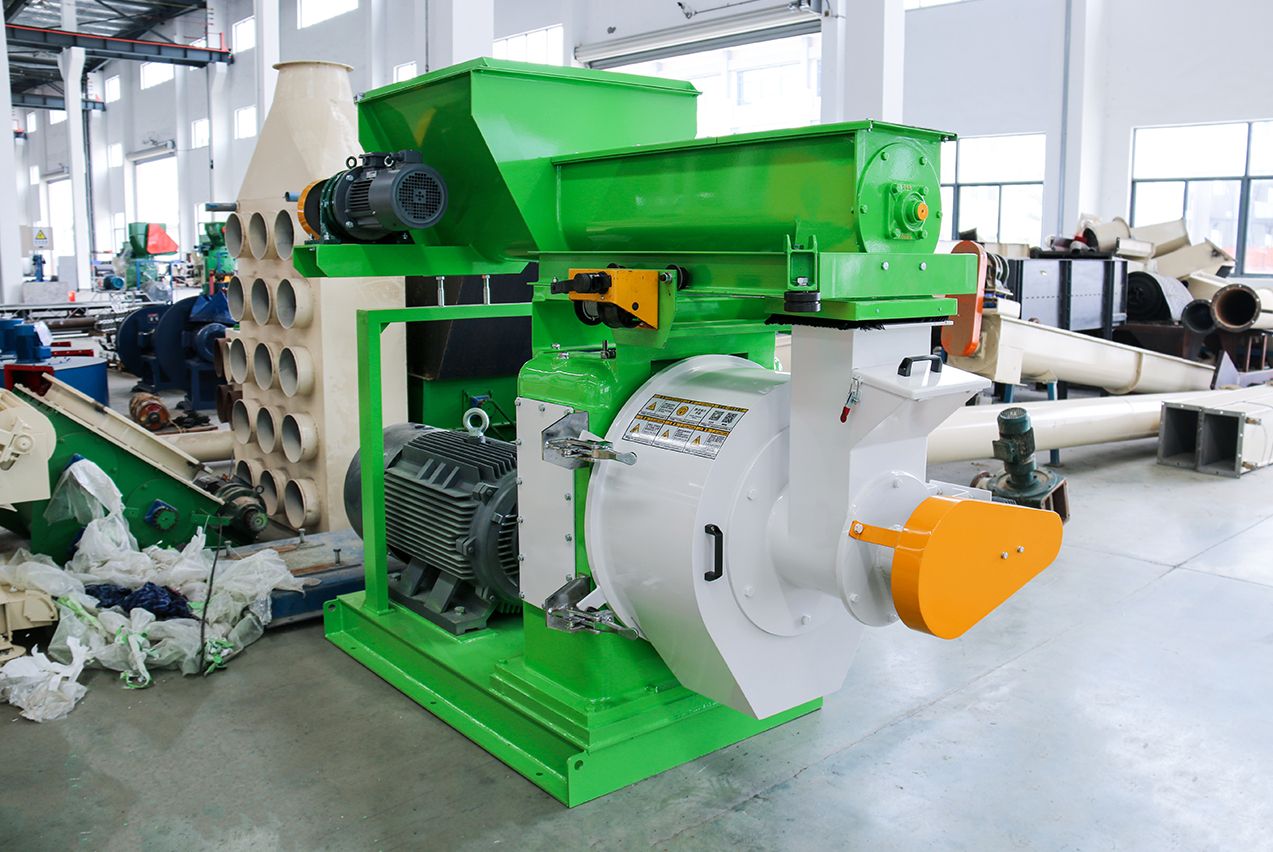
3. Pelletizing Dried husk enters the pellet mill, where the ring die and roller system compress material through precision-drilled die holes under high mechanical pressure. Friction heat generated during compression activates the natural lignin binders present in the husk, producing self-bonded pellets without chemical additives. Kingwood’s JWZL-series vertical pellet mills — including the JWZL-688 (2–2.3 t/h) and JWZL-928 (4–5 t/h) — are engineered for high-silica, abrasive feedstocks including rice husk.
4. Cooling Freshly formed pellets exit the die at 70–90°C. A counter-flow cooler reduces pellet temperature to within 5°C of ambient before packaging — a critical step that prevents moisture re-absorption, condensation damage in storage, and spontaneous combustion risk in bulk storage facilities.
5. Packaging and dispatch A pellet packaging machine completes the line, producing bagged product suitable for domestic industrial delivery or export container loading.
Kingwood designs complete wet-feed pellet production lines scalable to 200,000 metric tons per year, incorporating fully automated material handling, enclosed conveyors, and integrated dust removal at each processing stage.
Equipment Selection Criteria for Industrial Rice Husk Pellet Plants
Selecting the correct rice husk pellet machine requires matching throughput requirements, feedstock characteristics, and site-specific operational constraints. The following criteria are directly relevant to B2B capital equipment procurement.
Throughput and scalability Kingwood’s vertical pellet mill range covers 1–1.5 t/h (JWZL-420) through 4–5 t/h (JWZL-928). For plants requiring higher aggregate throughput, multiple units are configured in parallel within a single automated production line. The JWZL-1068 addresses capacity requirements above the JWZL-928 range — contact Kingwood sales for current specifications.
Die material and wear resistance Rice husk contains 15–20% silica (SiO₂) by dry weight — substantially more abrasive than wood chips or cereal straw. Ring dies for rice husk service require alloy steel with surface hardness specifications appropriate for high-silica feedstock. Die replacement intervals and spare parts lead times must be factored into total cost of ownership models at the procurement stage.
Dust management Rice husk generates fine particulate at every processing stage — crushing, drying, conveying, and pelletizing. Kingwood’s dust-free production line design, a core pillar of the Three-Standardization Framework, incorporates enclosed conveyors, negative-pressure extraction points, and bag-filter dust collectors throughout the line. Regulatory compliance in most target markets — including China, the EU, and Southeast Asia — makes this a baseline requirement rather than an optional upgrade.
Automation level For plants operating above 5 t/h, fully automated PLC-controlled lines reduce labor requirements, improve process consistency, and enable remote monitoring and fault diagnostics. Kingwood’s integrated production line designs include automated feed rate control, temperature monitoring, and alarm systems as standard for commercial-scale installations.
For a reference deployment demonstrating large-scale integration principles applicable to rice husk lines, Kingwood’s 24 t/h wood chip pellet production line commissioned in Vietnam in 2023 illustrates the automated, enclosed-line architecture used across high-throughput biomass pellet projects.
Environmental Compliance and Commercial Viability
Rice husk pellets comply with emission standards below GB13271-2001, China’s national Emission Standard of Air Pollutants for Boilers, and are accepted under EU biomass fuel frameworks. Their low sulfur content (<0.3%) makes them viable in markets where SO₂ emissions are tightly regulated — including Japan (≤0.5% sulfur standard) and EU member states.
Commercially, rice husk carries minimal raw material cost in rice-producing regions across Southeast Asia, South Asia, and East Africa. The primary capital investment is the processing line; ongoing operating costs are dominated by energy inputs for drying and pelletizing, plus scheduled maintenance. At a 40–50% fuel cost reduction versus coal or heavy oil, well-specified industrial lines typically achieve payback within two to three years of full operation.
Kingwood — established in 1999 and listed on the NEEQ (stock code: 871765) — has planned and designed over 2,000 production line projects across 30 countries. The company’s 25,000 m² production facility at Liyang Zhongguancun Industrial Park, Jiangsu Province, supports manufacturing, factory acceptance testing, and commissioning support for complete rice husk and biomass pellet lines. All equipment is produced under ISO 9001 and ISO 14001 quality management systems and carries CE certification.
FAQ
What is a rice husk pellet machine and how does it work?
A rice husk pellet machine is industrial pelletizing equipment that compresses dried rice husk under high pressure and temperature into dense, cylindrical fuel pellets. The ring die and roller system forces material through precision-drilled die holes, producing pellets typically 6–10 mm in diameter. Kingwood's vertical pellet mill series — including the JWZL-688 and JWZL-928 — are suited to rice husk processing due to their adjustable die gap and robust roller configuration.
What moisture content does rice husk require before pelletizing?
Rice husk must be dried to below 15% moisture content before entering the pellet mill. Excess moisture causes poor pellet cohesion, increases energy consumption, and accelerates die wear. In a complete wet-feed production line, a drum dryer is installed upstream of the pellet mill to bring high-moisture husk down to the required range before pelletizing.
What are the energy specifications of rice husk pellets?
Rice husk pellets produced on Kingwood equipment can achieve a calorific value of up to 4,800 kcal/kg, moisture content below 15%, sulfur content below 0.3%, and ash content below 18%. These figures comply with EU moisture standards (<15%), ISO ash standards (<20%), and China's GB13271-2001 boiler emission standard, making them suitable for industrial boilers and combined heat and power (CHP) applications.
How much can rice husk pellets reduce industrial fuel costs?
Switching from coal or heavy oil to rice husk pellets can reduce fuel costs by 40–50%, based on Kingwood operational data. Rice husk is typically a zero-cost or near-zero-cost agricultural byproduct in rice-producing regions, meaning the primary ongoing cost is processing — drying, grinding, and pelletizing — rather than raw material procurement.
What capacity range is available for rice husk pellet production lines?
Kingwood offers vertical biomass pellet mills ranging from 1–1.5 t/h (JWZL-420) to 4–5 t/h (JWZL-928), with complete integrated production lines scalable up to 200,000 metric tons per year. For large-scale rice husk pellet plants, multiple pellet mills can be configured in parallel within a fully automated, dust-free production line layout.
What auxiliary equipment is required alongside a rice husk pellet machine?
A complete rice husk pellet production line typically includes: a hammer mill for size reduction, a drum dryer to reduce moisture below 15%, the pellet mill itself, a counter-flow cooler to bring pellet temperature down before packaging, and a pellet packaging machine for bagging and dispatch. Kingwood designs and supplies all these components as an integrated system, including centralized dust removal and automated controls.
Does rice husk pellet production require dust control systems?
Yes. Rice husk is a fine, lightweight material that generates significant airborne dust during crushing, drying, and conveying. Industrial installations require enclosed processing, negative-pressure dust extraction, and bag-filter or cyclone separator systems. Kingwood's dust-free production line design — one of the three pillars of its Three-Standardization Framework — addresses this through fully enclosed conveyors, integrated dust removal at each processing stage, and sealed pellet mill housings.
- Global rice production generates approximately 120 million metric tons of rice husk annually, representing one of the largest volumes of agricultural biomass waste available for energy conversion. (2023, Food and Agriculture Organization of the United Nations (FAO), FAOSTAT Rice Production Database)
- Biomass energy accounted for approximately 55% of total renewable energy consumption globally, with agricultural residues including rice husk identified as a priority feedstock for pellet fuel production in Southeast Asia and South Asia. (2023, International Energy Agency (IEA), Renewables 2023 Report)