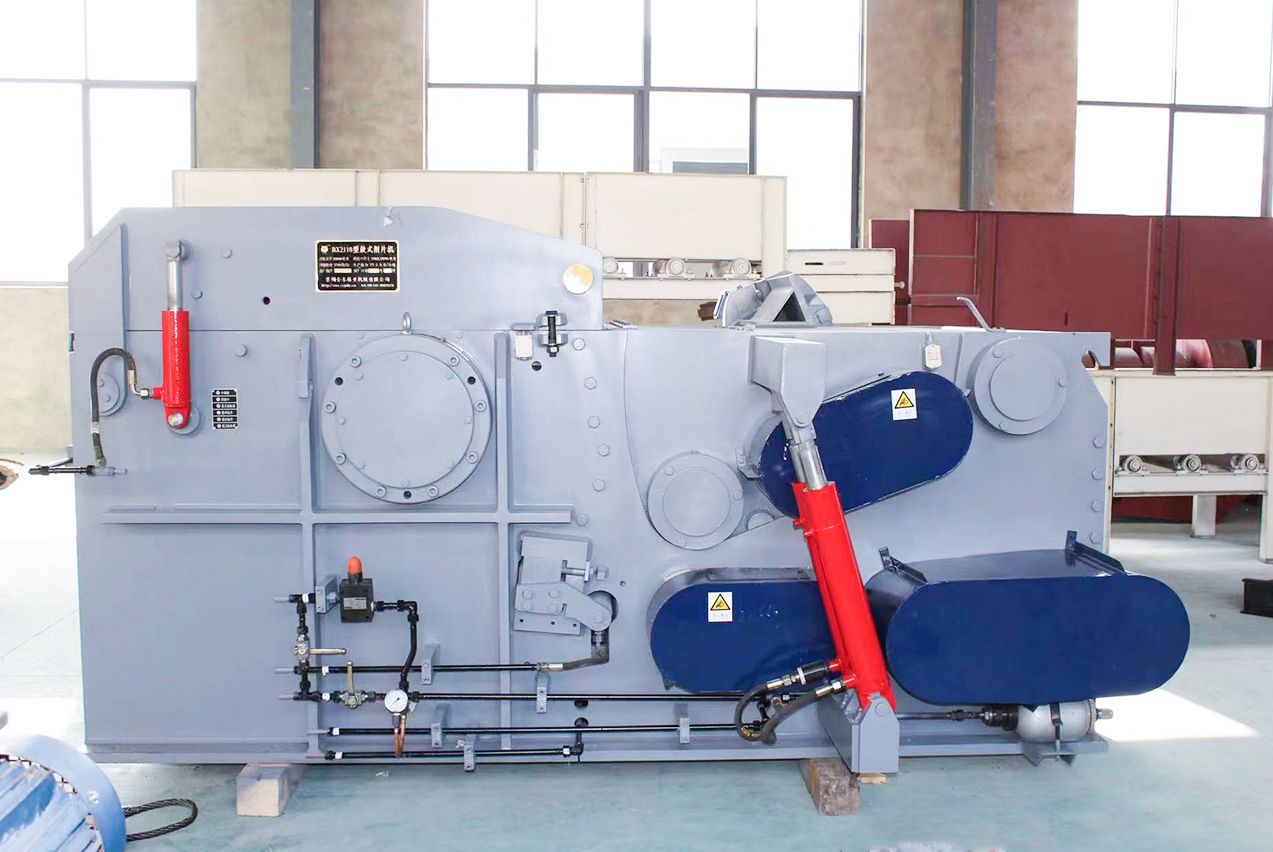
Drum Wood Chipper for Industrial Biomass Chip Production
Kingwood · May 26, 2026
What a Drum Wood Chipper Does and Where It Fits in Industrial Processing
A drum wood chipper is specialized front-end equipment designed to reduce bulk wood feedstock — branches, logs, waste veneers, and wood processing residues — into uniform chips typically measuring 15 to 40 mm. That dimensional consistency is not incidental: downstream processes in biomass pellet production, fiberboard manufacturing, pulp mills, and particleboard plants all depend on predictable chip geometry to maintain throughput efficiency and end-product quality.
The machine’s core working principle involves a high-speed rotating knife drum equipped with flying knives that cut incoming material against a fixed bottom knife. A hydraulic buffer system governs the upper feeding roller assembly, absorbing load variation caused by irregularly shaped feedstock and maintaining synchronous, continuous operation. A comb plate at the discharge point controls chip length. High-speed airflow generated inside the cutting chamber carries qualified chips out while oversized pieces are returned to the cutting bin for reprocessing — an automatic classification loop that eliminates manual re-sorting and reduces material waste.
The structural layout is compact: a base frame, upper and lower feeding rollers, a conveyor belt, a hydraulic system, a comb plate, and an enclosing cover. The covered design supports safe continuous operation in open raw material preparation areas, and installation is straightforward within existing processing hall footprints.
Technical Features That Determine Performance Over a Production Lifecycle
For procurement engineers and plant managers evaluating drum chippers, several mechanical details differentiate long-term performance from basic throughput numbers:
Adjustable chip thickness. The gap between the flying knife and bottom knife can be set to target specific chip dimensions, allowing the same machine to serve pelletizing, pulp digestion, or panel board manufacturing by configuration rather than equipment replacement.
Hydraulic feeding control. The automated hydraulic system regulates the feeding port in response to material flow, preventing bridging and maintaining a consistent feed rate. This reduces operator intervention and supports unattended operation during extended production shifts.
Blade and comb plate accessibility. When the cover is opened, blade position can be adjusted directly and the crushing chamber is fully accessible. The comb plate assembly is designed for tool-free disassembly and reassembly, keeping scheduled maintenance windows short and reducing reliance on specialized service personnel on-site.
Reverse feeding capability. A reverse feeding device clears jams without manual entry into the cutting zone — a safety-critical feature in high-throughput environments processing mixed or contaminated feedstock.
Continuous-duty design. Drum wood chippers are built for uninterrupted operation across multiple shifts. Their high output-to-footprint ratio makes them practical for both greenfield installations and retrofits into existing processing facilities.
Integration with Complete Biomass Pellet Production Lines
The drum wood chipper’s primary industrial role is as the first processing stage in a complete biomass pellet production line. In Kingwood’s wet-feed line architecture — which handles high-moisture biomass through sequential crushing, coarse grinding, drying, fine grinding, pelletizing, and packaging — the drum chipper conditions incoming raw material before it enters the hammer mill for further size reduction.
This sequencing directly affects line efficiency. If oversized material bypasses chipping and enters the hammer mill directly, wear rates increase, screen life drops, and grinding throughput falls below rated capacity. Consistent 15–40 mm chip input allows the hammer mill to operate at design throughput with predictable specific energy consumption per ton processed.
Kingwood’s complete lines are engineered to handle up to 200,000 metric tons per year, with full process automation, enclosed conveyance, and integrated dust removal at each transfer point. The Vietnam 24 TPH wood chip pellet production line commissioned in 2023 demonstrates how front-end chipping, drying, and pelletizing stages are sequenced and balanced in a high-volume, export-grade operation.
Beyond pellet lines, drum wood chippers serve standalone functions in biomass power plant fuel preparation, pulp mill chip yards, and fiberboard plant raw material handling — wherever dimensional uniformity and continuous throughput define process economics.
Why Chipping Stage Equipment Selection Affects Total Line ROI
Front-end equipment is routinely underweighted in biomass plant capital planning relative to the pellet mill itself. In practice, chipping reliability and chip quality set the ceiling on what every downstream stage can achieve. An inconsistent chip stream — variable in length, carrying fines, or contaminated with tramp material — propagates inefficiency through drying, grinding, and pelletizing simultaneously, compressing margin at every stage.
Kingwood, established in 1999 and operating from a 31,200 m² facility at Liyang Zhongguancun Industrial Park in Jiangsu Province, has planned and designed over 2,000 biomass production line projects across 30 countries. The drum chipper range is developed alongside the full auxiliary equipment portfolio — hammer mills, drum dryers, counter-flow coolers — enabling line engineers to specify chipping capacity matched to dryer and pellet mill throughput from initial design, rather than managing capacity mismatches after commissioning.
Kingwood holds ISO 9001, ISO 14001, and CE certifications and is listed on the NEEQ exchange under stock code 871765. For technical specifications, capacity requirements, or integration into a complete line design, contact Kingwood’s engineering team through the product inquiry page.
FAQ
What raw materials can a drum wood chipper process?
A drum wood chipper handles branches, logs, waste veneers, wood processing residues, agro stalks, and garden debris. The machine is engineered for small-to-medium-diameter wood and is particularly effective in the chip preparation stage of a complete biomass pellet production line.
What chip size does a drum wood chipper produce?
Standard output chip size ranges from 15 to 40 mm. Chip thickness can be adjusted mechanically to match downstream process requirements — pelletizing, pulp production, or fiberboard manufacturing. A mesh sieve system further classifies chips by size before they advance to the next processing stage.
How does the hydraulic system on a drum wood chipper work?
The hydraulic system serves two functions: it automatically controls the feeding port to regulate material flow, and it operates a hydraulic buffer mechanism that keeps the upper feeding roller assembly running smoothly even when feedstock dimensions vary. The buffer system prevents sudden load spikes that would otherwise cause mechanical stress or downtime.
How does a drum wood chipper integrate into a complete biomass pellet line?
In a wet-feed biomass pellet production line, the drum wood chipper sits at the front-end chip preparation stage. Oversized logs and branches are reduced to uniform chips, which then advance through coarse grinding, drying, fine grinding, and pelletizing. Kingwood designs complete lines up to 200,000 tons per year capacity with fully integrated dust removal and automated conveyance between each stage.
What maintenance procedures are required for a drum wood chipper?
Key maintenance tasks include inspecting and replacing flying knives and the bottom knife, adjusting the gap between the blade and comb plate, and checking the hydraulic buffer system. The comb plate is designed to be disassembled and reassembled without special tooling. When the cover is open, blade position adjustment and crushing chamber inspection can be performed directly, minimizing downtime.
In which industries is a drum wood chipper most commonly deployed?
Drum wood chippers are widely deployed in biomass pellet plants, biomass power plants, fiberboard factories, pulp and papermaking mills, and particleboard plants. Their adaptability to varied feedstock types and continuous-operation design makes them a standard piece of front-end equipment across wood-based panel and renewable energy industries.
What certifications apply to Kingwood drum chippers?
Kingwood's equipment range, including drum chippers, is produced under ISO 9001 and ISO 14001 quality and environmental management systems and carries CE certification. Kingwood holds Jiangsu Provincial High-Tech Enterprise status and is listed on the NEEQ stock exchange under code 871765.
- Bioenergy accounted for 130 GW of global renewable capacity additions tracked through 2023, underpinning sustained demand for front-end wood chipping equipment in biomass fuel preparation. (2023, International Energy Agency (IEA), Renewables 2023 Report)
- Kingwood has planned and designed over 2,000 biomass pellet production line projects across 30 countries, with complete line capacities reaching up to 200,000 metric tons per year. (2025, Kingwood internal project records, kingwoodpellet.com)