What Is a Biomass Pellet Production Line?
Kingwood · May 26, 2026
What a Biomass Pellet Production Line Does
A biomass pellet production line is a set of integrated equipment that converts raw forestry and agricultural residues—sawdust, wood chips, rice husks, corn stalks, bark—into dense, standardized fuel pellets for industrial boilers, power plants, and commercial heating systems. The finished product achieves a calorific value of 4,800 kcal/kg, moisture content below 15%, and sulfur content below 0.3%, satisfying China’s GB13271-2001 boiler emissions standard and major international import specifications including EU, US, and Japanese thresholds.
A complete production line is not a collection of standalone machines. It is a sequenced, matched workflow in which each stage—size reduction, moisture control, fine grinding, compression, cooling, and packaging—must be engineered to compatible throughput and operating parameters. Mismatched capacity at any single stage creates bottlenecks that degrade output quality and reduce line availability.
The economic case is well established. Industrial operators transitioning from coal or heavy fuel oil to biomass pellets typically reduce fuel costs by 40–50%. A 12 t/h wood pellet line installed in Vietnam in 2024 achieved full capital payback within 23 months—a result that reflects both the fuel cost differential and consistent line productivity under commercial operating conditions.
Core Equipment Stages and Their Functions
Stage 1 — Size Reduction: Drum Chipper and Hammer Mill
Incoming raw material rarely arrives in a form suitable for direct pelletizing. A drum chipper reduces large logs, branches, or agricultural stalks into chips of manageable size. A hammer mill then grinds those chips to a fine, uniform particle size—typically 3–5 mm—required for efficient compression through the pellet mill die. Particle uniformity at this stage directly determines pellet density and mechanical durability downstream.
Stage 2 — Drying: Drum Dryer
High-moisture feedstock is the primary cause of poor pellet quality, accelerated die wear, and avoidable energy waste. A drum dryer reduces feedstock moisture to below 15% before the material reaches the pellet mill. In Kingwood’s wet-feed production line architecture, drying is positioned after initial size reduction so that heat is applied to material already broken down to consistent particle sizes—improving thermal efficiency and reducing dryer fuel consumption relative to drying whole or oversized material.
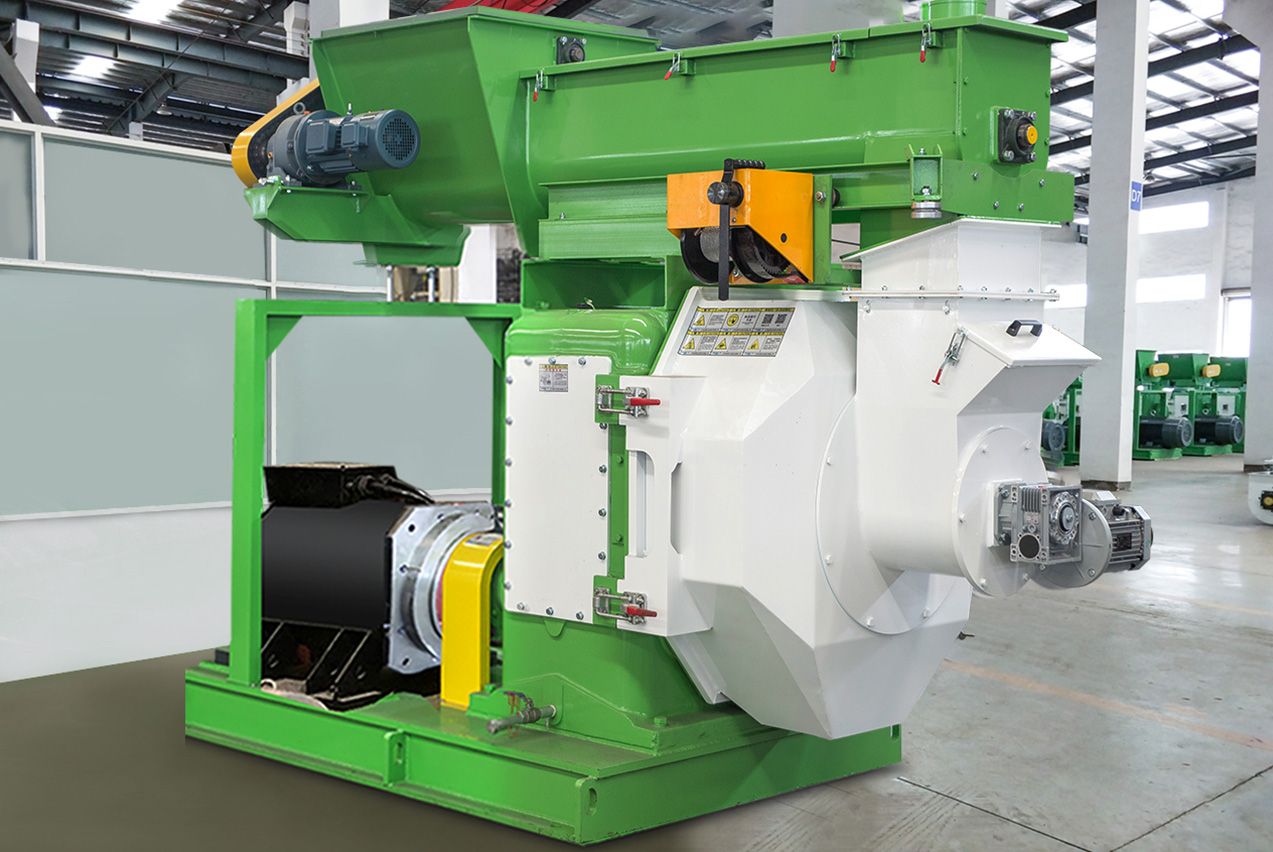
Stage 3 — Pelletizing: Ring Die Pellet Mill
The pellet mill is the central production unit. A ring die—a cylindrical steel component with precision-drilled holes of fixed diameter—compresses prepared feedstock under high pressure. Rollers force material through the die holes; the resulting friction and pressure generate sufficient heat to activate natural lignin in the biomass, which functions as a binding agent. For most wood-based feedstocks, no supplementary binders are required. Die hole diameter determines pellet size, which typically falls between 6 mm and 10 mm for industrial fuel applications.
Kingwood’s vertical pellet mill range—the JWZL-420, JWZL-688, JWZL-688D, and JWZL-928—covers throughput from 1 t/h to 5 t/h per unit. The horizontal JZWH-860 delivers 4–5 t/h in a configuration suited to specific plant layout requirements. For higher aggregate throughput, multiple mills operate in parallel within a single automated line. Complete line configurations can be designed to annual capacities up to 200,000 metric tons.
Stage 4 — Cooling: Counter-Flow Cooler
Pellets exit the die at elevated temperature with residual surface moisture. A counter-flow cooler reduces pellet temperature to near-ambient before packaging. This step is operationally critical: hot pellets are dimensionally unstable, prone to surface cracking, and will degrade packaging material. Controlled cooling also finalizes pellet hardness and reduces the risk of spontaneous heating during bulk storage and transport.
Stage 5 — Packaging
Cooled pellets are conveyed to a packaging machine. Industrial formats typically include 15 kg or 20 kg bags for commercial distribution, or bulk handling configurations for direct power plant delivery. Packaging documentation—pellet grade, moisture content, calorific value—is required by most end-use contracts and import regulatory frameworks.
Design Considerations for Industrial-Scale Lines
Specifying individual machines is straightforward. Engineering a production line that sustains consistent output, controlled dust levels, and low unplanned downtime across operating shifts requires system-level design expertise. Three factors consistently determine long-term line performance in industrial deployments:
Feedstock variability. Mixed agricultural and forestry residues vary significantly in moisture content, bulk density, and fiber structure. A line optimized for clean, dry sawdust will underperform—or fail entirely—when processing wet bark, rice husks, or mixed municipal wood waste. Kingwood’s wet-feed production line design treats drying capacity as a primary engineering parameter, not an optional add-on, enabling the line to handle high-moisture biomass from the intake stage without process interruption.
Dust control and operator safety. Biomass processing generates significant airborne particulate at every transfer and grinding point. Kingwood’s Three-Standardization Framework—Integrated, Dust-Free, and Automated production line design—embeds enclosed conveyors, integrated dust removal systems, and sealed transfer points throughout the line as standard design elements. The dust-free biomass pellet mill workshop completed in Guizhou in 2024 demonstrates this approach at full commercial scale.
Automation and throughput consistency. Manual intervention points introduce output variability and create labor dependency that compounds at scale. Fully automated lines with PLC control monitor feed rates, dryer temperatures, pellet mill load, and cooler throughput in real time, enabling a single operator to manage a multi-machine line and respond to process deviations before they cause downtime or quality defects.
Since 1999, Kingwood has planned and designed over 2,000 biomass pellet production line projects across 30 countries. The engineering team of 20 R&D experts provides process design, equipment selection, plant layout, installation, commissioning, and operator training as an integrated project package. For throughput requirements, feedstock assessment, or project-specific line sizing, contact Kingwood’s technical sales team directly.
FAQ
What does a biomass pellet production line consist of?
A complete line typically includes a drum chipper, hammer mill, drum dryer, pellet mill (ring die type), counter-flow cooler, and pellet packaging machine. Depending on incoming raw material moisture and particle size, auxiliary conveyors, dust removal systems, and screening equipment are integrated to form a fully enclosed, automated process.
What raw materials are suitable for biomass pellet production?
Common feedstocks include wood chips, sawdust, bark, rice husks, corn stalks, and other agricultural or forestry residues. Raw materials with a moisture content below 15% perform best; higher-moisture feedstocks require drying before pelletizing to ensure pellet durability and consistent calorific output.
What role does the ring die play in a pellet production line?
The ring die is the core compression component of the pellet mill. Feedstock is forced through fixed-diameter die holes under high pressure and heat generated by friction, forming dense cylindrical pellets of consistent diameter. Die hole size determines final pellet diameter, which typically ranges from 6 mm to 10 mm for industrial biomass applications.
Why is drying a critical step in biomass pellet production?
Excess moisture in raw material reduces pellet density, mechanical durability, and calorific value. It also increases energy consumption during pelletizing and can cause die blockages. A drum dryer reduces feedstock moisture to below 15% before grinding and pelletizing, which is the threshold required by both EU standards and Kingwood's fuel specification.
What throughput capacities are available for biomass pellet production lines?
Kingwood designs complete wet-feed biomass pellet production lines across a wide capacity range. Individual pellet mills in the Kingwood lineup include the JWZL-420 (1–1.5 t/h), JWZL-688 (2–2.3 t/h), JWZL-688D (3–3.5 t/h), JWZL-928 (4–5 t/h), and the horizontal JZWH-860 (4–5 t/h). Multi-machine complete line configurations scale significantly higher—contact Kingwood sales for project-specific sizing.
What fuel quality specifications do Kingwood biomass pellets meet?
Kingwood biomass pellets achieve a calorific value of 4,800 kcal/kg, moisture content below 15%, sulfur content below 0.3%, ash content below 18%, and dioxin content below 0.5 ng TEQ. All emission indicators comply with GB13271-2001, China's national Emission Standard of Air Pollutants for Boilers, and meet EU, US, and Japanese import standards.
How much can biomass pellets reduce fuel costs compared to fossil fuels?
Switching from coal or heavy fuel oil to biomass pellets can reduce industrial fuel costs by 40–50%, based on Kingwood project data. Actual savings depend on local fossil fuel pricing, boiler efficiency, and pellet logistics. A 12 t/h Vietnam installation completed in 2024 achieved full investment payback within 23 months.
- Global wood pellet production reached approximately 42 million metric tons in 2023, with demand from industrial power and heat sectors accounting for over 80% of consumption. (2024, IEA Bioenergy — Key Trends in Renewable Energy 2024)
- Biomass energy supplied roughly 9.4 EJ of heat to industrial processes globally in 2022, making it the single largest renewable heat source in the industrial sector. (2023, IEA Renewables 2023 Report)